Child and Brain: The Stages of Development
When your baby is born his brain weighs about 350 g (12 oz); by his first birthday it weighs 1 kg (2.2 lb).At birth, the brain already has some 200 billion neurons (nerve cells) . Human brain begins in the foetus stage. Early brain development starts within three weeks of conceiving.The brain development starts at an early stage which depends on the events that takes place during the brain which depends on Mothers external and internal stimulus.
These events are also responsible for putting in all the memories and information. This process is a life long process and it never stops.The brain develops in two stages.The prenatal and postatal stage. As the name suggests the prenatal early brain development begins when the baby is inside the womb as a foetus. The brain begins to work before the baby is born. The second stage of development starts after the birth of the baby. This is called the postnatal stage. It is also an early brain development stage of the baby.
Scientists say that the brain of a child is very much impressionable or plastic, this is also termed as brain plasticity. It means in the early brain development stage the brain can memorise and learn more than adults. But most of us donot know this fact.
In the later stage the brain slowly looses its plasticity. For this reason a human being can not easily remember everything he or she learns in adulthood. It is the early stage of the brain that is very vital ( Birth – 5 years), more than any other point of time in life, for growth of the intellectual and emotional faculties.
The child learns from the environment where she or he lives. A child can quickly adopt the skills he or she watches in the environment. If the environment is not helpful for the child’s enrichment, it will give a negative impact on the child’s brain which is in an early brain development stage.
Each neuron responds to stimulation by growing a network of dendrites (branches) and synapses (connections) between itself and its neighbors.Each neuron ends up with dendrites leading to an average of 15,000 synapses. Dendrite formation becomes more complex over time, with third- and fourth-tier branches appearing by 6 months of age.
The more stimulation the brain receives, the more sophisticated its dendritic networks become.The frontal lobe (the part of the brain that deals with emotions) becomes highly metabolically active from 6 months of age. By 18 months the neural foundations of your baby’s emotional intelligence are laid. Between 2 and 4 months of age, the number of synapses in your baby’s visual cortex increases tenfold to 20,000 per neuron. By 12 months of age, neurons that distinguish native language have found their permanent position in the brain. At 18 months the language center of the brain experiences a massive synaptic spurt, producing an explosion in grammar.
So parents should understand the importance of Holistic approach and provide a knowledge rich environment even while the child is in womb
Piecing Together the World
Consider the physical act of vocalization. Recognizable words are a long journey from the muttering of those first few infant noises. Words are formed gradually, using a process called auditory feedback, a two-part process in which control over the muscles responsible for speech results from the practice of mumbling endless streams of vowel sounds, and, through mimicry, those sounds are gradually matched up with the human speech sounds the child hears. In the language of developmental psychologists Alison Gopnik, Andrew Meltzoff, and Patricia Kuhl, a child is a scientist of sorts, constantly comparing what he or she perceives between the varying worlds of touch, sight, and sound; in short, piecing together the puzzle of a new world. At two or three months, a child is not yet making sense of language, but through auditory feedback becomes familiar with the sounds of language, and how to separate and reproduce them. These “sounds” are called phonemes, the smallest sounds in language that can change meaning, and they are catalogued at birth. Out of several hundred possible phonemes, the English language uses 44. By two and a half months, an English speaking child is already cooing nearly exclusively in these sounds. Early on, nerves in the brain discern any of the hundreds of known phonemes—this is why a newborn can feasibly learn any language. But at the end of one year a child exposed to just one language will only be able to recognize the phonemes used in that native speech. It is no coincidence that at around this time children begin to produce their first words. A certain amount of early development is purely physical, purely the gaining of strength. When a child can raise his or her head completely, without assistance (at 2 to 4 months) or sit with no support for the first time (at 5 to 6 months) and, later, can walk (at 11 to 15 months)—these are milestones largely wrought from simple muscle maturation. But what about when, at about 1 month, a child first perceives that one toy is closer than another? Or at 2 to 4 months turns to the sound of a rattle?
The Advent of Depth Perception
Like vocalization, development of depth perception is the result of improved cortical processes. Spatial perception improves when connections in the brain’s primary visual cortex are refined. At birth, all cells in the primary visual cortex receive input from both eyes; only later will some receive input exclusively from the right eye or the left. Before the functional connections are refined, a newborn’s brain cannot distinguish between the images apprehended by each individual eye, and sees without perspective. The experience is the equivalent of listening to a compact disc through an old, mono-radio. Perceiving in “stereo” (binocularity), conversely, separates the different parts of the music, creating space between objects. Though the image a newborn sees is complex, the visual processing system considering the image is not yet developed, and the result is an inability to calculate distance to objects. Binocularity develops in the first month through a process of synaptic competition as the neurons in the primary visual cortex are eventually assigned to one eye or the other. Through this process, the visual cortex maintains two slightly different images of the object within the field of vision. The brain takes these images and integrates them, resulting in a more complex picture—forming perspective with distance and depth.
Turning to Sound
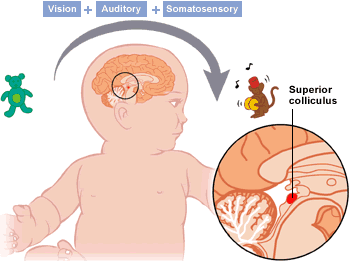
Similarly, a child first turning to observe a sound exhibits the maturation of a number of different processes. In the first months, there is an assortment of maps concurrently developing in the brain that are independent of one another—including a visual map, an auditory map, and a somatosensory, or tactile map. Only after maturation and integration of these processes can a child hear a sound and, by connecting the visual, auditory, and somatosensory maps, locate its origin.
When experience brings these maps into sync — sometime between 2 and 4 months — the sound sets off a extraordinary series of events all orchestrated by the superior colliculus, the part of the brain responsible for orienting the head. The sound reaches the superior colliculus, and is identified as “to my left” on the auditory map. The visual map, similarly informed by the superior colliculus, knows that the origin of the sound is beyond the field of vision, and from the somatosensory map, exactly how far the head must be turned to locate the sound. Finally, the superior colliculus sends a message to the muscles in the neck to move the head to that position, and the sound is precisely centered within the child’s gaze.
Conclusion
There are really just a handful of processes that a developing brain employs in order to make sense of the world. All generally involve the expansion and elaboration of the nervous system coupled with careful observation and cataloging of environment. It is amazing that a child, who does not yet have a name for memory, is successfully using this complicated, if fundamental, function even before birth. A child’s daily learning curve is so steep that we surely cannot even grasp its acceleration, let alone try to compare it to a particularly fruitful day in our own lives. The processes unfolding inside the brain catapult learning exponentially in those first crucial years. One might be tempted to set up parameters for when and how important events should transpire. And this is useful, even necessary. But it is important to keep in mind that growth and development, language and physical maturation, intelligence and sense of self in the world, do not emerge in a vacuum, but rather arise in a complex, interwoven, and unique interaction between the child and the environment. A child’s development defies simple textbook descriptions of isolated benchmarks — children develop in the world, not on a growth chart.